

The Movie Group
From Silence To Sound

It’s August 6, 1926. Sam Warner, one of the four founding brothers of Warner Brothers Pictures, takes a long, deep drag on his cigarette to help calm his nerves outside the Warner Theater at Broadway & 52nd Street in New York City. The bright lights on the facade of the building highlight the growing beads of sweat dripping from his face, which is only made worse by the summer heat and humidity. He wipes his brow with the handkerchief from his suit pocket before taking one last slow inhale on his cigarette and walking into the building.
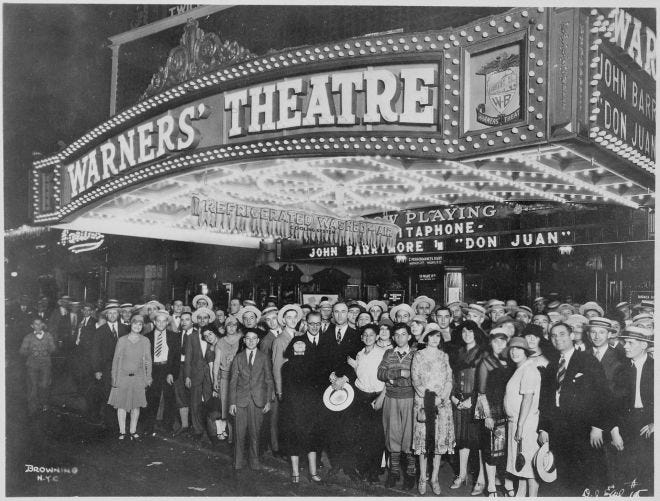
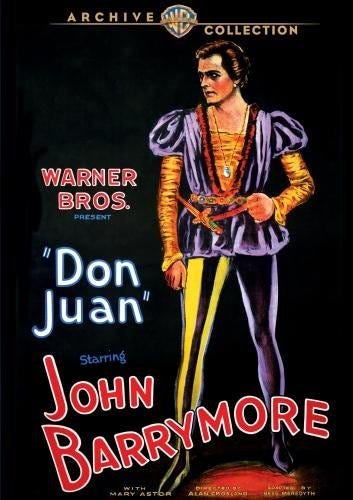
Sam has every reason to be nervous tonight. His company is a midsize film studio among the heavyweights like Paramount and MGM, and he has essentially bet the entire company on tonight’s outcome. In the previous year Western Electric, a subsidiary of AT&T, developed a new electric sound recording system. Not only did this create much better audio recordings, but they also used it to create Vitaphone, their patented synchronized sound system. This revolutionary system allowed for sound to be synchronized with film. Before this breakthrough movie theaters paid bands or pianists to perform live music along with the movie while seated in a music pit in front of the stage. And tonight was the premiere of Warner’s latest film, '“Don Juan.”
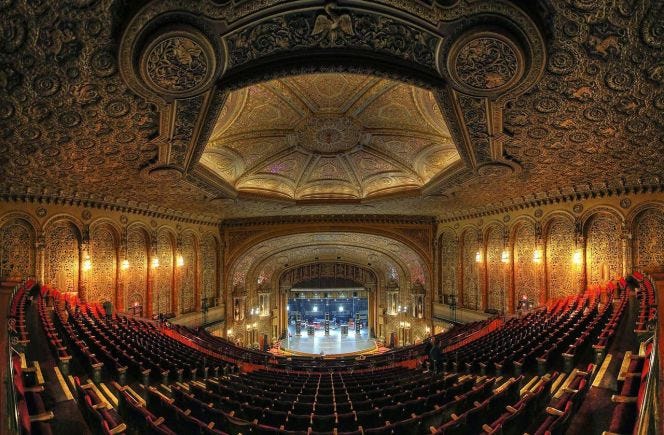
But the story and the film itself wasn’t the real draw to this event—it was the intrigue around the film’s use of synchronized sound. The Warner Theater was specifically designed to host such a sophisticated system of sound equipment, the first of its kind. It was a grand, ornately decorated movie palace. It wasn’t a place to go to casually watch a movie. It was a destination to be enthralled by the wonders of the art that could be produced with the use of new technologies like Vitaphone. And all this wasn’t cheap. It cost the already cash-strapped company $2M to build (a not so small fortune at the time).
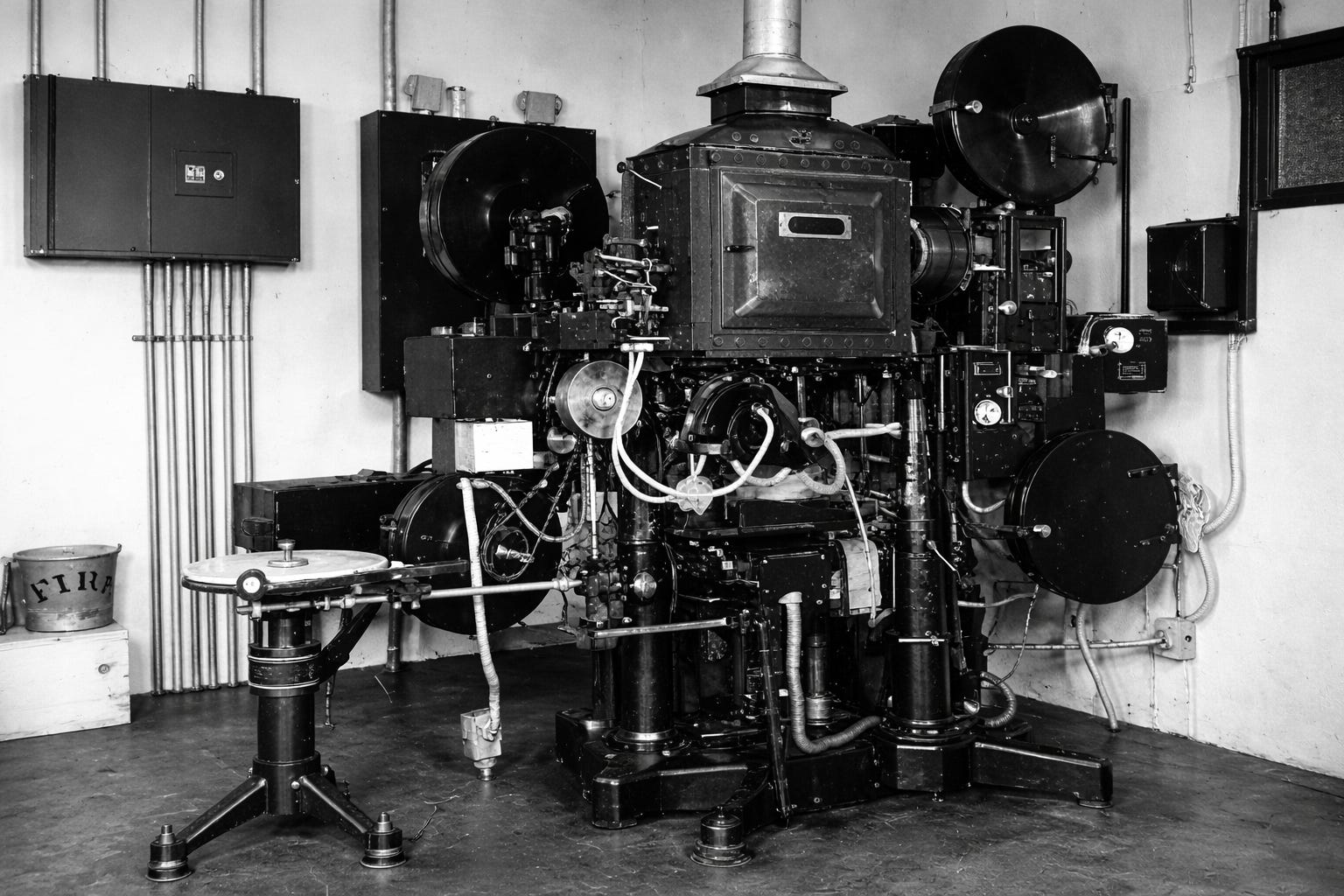
The Vitaphone system used phonograph records to play the sound that would accompany the movie. But it wasn’t perfect. It would occasionally experience skips on the record and could become desynchronized. If Warner wanted to call tonight’s showcase of this technology a success and leverage it to propel them into the top tier of the industry’s studios, they would need everything to go off without a hitch.
After a quick shot of liquid courage, Sam joins his brothers in the theater as the crowds flooded in. As the lights dim and the cacophonous sounds of the eager moviegoers begin to fade into a suspenseful silence, Harry Warner, the skeptical president of the company, gives his brother a reassuring pat on the shoulder. The large red velvet curtains at the front of the theater open to reveal the screen where the film’s credits begin and the new Vitaphone sound system is started for the world’s first showing of a feature-length synchronized sound movie.
In order to really get a sense of the meaning of this premiere and the technology it showcased, we first need to take a look at how the movie business developed in the prior decade.
The American Movie Business
In 1914, Paris was the cultural capital of the world. Anything French was seen as being of high quality and sophisticated. France dominated global art, French is the lingua franca, the great authors, painters, and philosophers of the world all live in Paris. On top of that, it was also the world leader in the production and distribution of motion pictures. Anywhere from 60%-70% feature-length films worldwide were exported from France. But with the onset of the World War in August, everything changed.
Although Paris would remain the cultural capital of the world for years to come, its film industry was completely devastated. Essentially all film production halted during the war. This allowed the American film industry to takeover leadership in the movie trade. America retained its physical infrastructure, was able to keep producing films during the war, and didn’t send nearly as many men to war as the French did. All of this meant that at the end of the war, America had taken France’s crown as king of the movies.
While American film companies came to dominate the global movie market, the business itself was not what most investors of the day were looking for in a great investing opportunity. The film business was cyclical, capital intensive, unstable and volatile. It could take over a million dollars to produce a large film with a complete absence of any certainty the film would generate a profit.
Studios had to put up hundreds of thousands of dollars or more upfront, then wait and hope for a return later. If the film flopped, a small fortune was flushed down the toilet. But sometimes a film could earn ten times its production costs or more. It was an industry truly built for gamblers.
One of the gambles the industry bet on was that of the movie palace. In the 1910s, in an effort to attract more respectable customers and more of the middle class to their theaters, companies like Famous Players-Lasky (what would later become Paramount Pictures) began to end the practice of showing their films in nickelodeons and small movie dens. Instead, they built larger, more respectable chain theaters. They would also build a handful of grand, elaborate movie halls that resembled European opera houses that could seat thousands of moviegoers as their flagship first-run theaters. The plan worked and helped improved the image of the business to appear more glamorous than it had been. However, these movie palaces weren’t cheap.
Not much in the movie business was cheap. There were the expensive movie palaces and theaters, the production costs of movies (which would grow and grow over the years as films became more elaborate), the operating costs associated with each theater, massive electricity bills, expensive film-making equipment, distribution, and advertising also weighed on the financial health of the movie companies. Vertically integrating the production, distribution, and exhibition of the studio’s movies helped to not only ease some of the financial burden, but also guaranteed their movies would be seen in theaters without having to negotiate with outside theater owners.
Another innovation the industry made in the 1910s was the transition into feature-length films. At the time, most movies were shorts—typically 10-20 minutes long. Many theater owners feared the audiences didn’t have the patience and attention span to sit through a single 90-minute movie, and most audiences expected a variety of short films. The enormous success of feature-length films like “The Birth of a Nation” (1915) helped cement the feature film as the industry standard. For longer runtimes the companies could charge a premium for these movies. They soon became the standard in the industry and would dominate the box offices in the decades to come.
Along with the rise of features came the rise of the movie star. At first, starring actors weren’t advertised and audiences didn’t even know their names. One of the first movie stars, Florence Lawrence, was simply known as Biograph Girl since she appeared in films by the Biograph Company. But studios saw potential in cultivating the attention and allure of their stars by marketing them as special, larger-than-life talent. This helped ensure fans of the stars would go out to see their movies. They invested heavily in crafting, protecting, and managing their public image to prevent any backlash from affecting ticket sales.
As the stars grew bigger and bigger along with sales of movie tickets, and competition for prestige among the studios grew, the productions also grew larger, more elaborate, and more expensive.
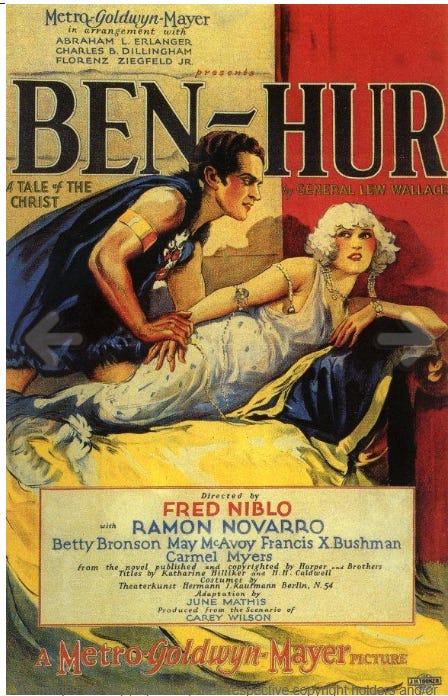
The studios soon were in competition to create bigger, more intricate, monstrous, epic films to bring prestige to their studios and to fill up their giant movie palaces. While the average film would cost between $100k-$250k, the epics like “Ben Hur” or “The Ten Commandments” could run between $1M-$4M. These movies used massive sets, thousands of extras, top-tier stars, intricate costumes, and frequently ran over budget.
The biggest of these early epics was MGM’s “Ben Hur.” They began filming the movie in Italy in 1923. However, due to chaos related to logistics, injuries, unusable footage, and cost overruns, they scrapped filming in Italy and returned to finish the movie in California, starting the movie at a loss of $1M, or roughly five times the average production cost for a movie. The movie’s famous chariot race scene alone cost close to $1M. The cast and crew added another $500k with stars and thousands of extras. The thousands of Roman costumes, armor, weapons, and animals used in the film ran about $250k. That’s already about $4M to produce the film before adding in advertising and promotional costs. Luckily for MGM, the movie became the biggest hit in the world when it was released in December 1925, grossing about $9M and netting them between $1M-$2M.
By around 1925 the changes seen in the film business over the past decade resulted in theater attendance soaring to 50M per week. That’s nearly half of all Americans going to see a movie every week. But even this incredible level of theater attendance wasn’t done growing yet. Rising levels of prosperity and one technological breakthrough would help to propel the industry to new heights.
The Sound of Silence
For essentially the entire history of the movie industry up to 1926 all movies had been silent movies. There was no audible dialogue. Separate screens with text displayed any dialogue or narration the producers wanted to add, and any music was performed live in the theater by musicians. But the Warner Brothers’ Don Juan would change all that. The premiere in New York was a major success. The sound stayed synchronized to the film and the audience loved hearing the sound effects during sword-fighting scenes. Although it contained no spoken dialogue and was seen as a decent film, the real buzz was around the incredible synchronized sound system, Vitaphone. It was mostly a proof-of-concept film. Sam Warner would see his vision pay off.
While most of the other film studios had relatively low volatile, slow-moving stocks as they were already massive and had cyclical, hit-driven businesses with large upfront financing needs, and owned the vertically-integrated layers of film production, distribution, and chains of theaters. Warner Brothers was a small studio that only produced movies, just recently acquired a distribution channel, and only owned two movie palaces. Now, they suddenly became the technological leader of the group, taking the industry from the auditory dark ages into the future of what films would later become. Because of this, their stock saw a massive amount of activity and shot up hundreds of percent.
Surprisingly, many people didn’t think that anyone wanted to listen to an actor’s voice. They thought that film was about visuals. On top of that, only about 10% of the world spoke English at the time, and movies were a global business. Some of the studios thought that if they began making sound movies with dialogue, they would be cutting off a large percentage of prospective customers who would otherwise have went to see their movies.
Of course, many of the movie stars themselves recoiled at the idea. They didn’t need to perform with their voice in the silent era and weren’t used to it. Some of them had odd voices that didn’t match what the audience expected from them. And other stars didn’t even speak English and would instantly be out of a job if their studio made the switch to sound. But some studios made the switch much faster than others.
Warner Brothers, who made the leap in becoming the first to use this technology quickly pivoted to dominate the new medium of sound pictures. A year after the successful release of “Don Juan,” they released what is widely considered to be the first talking movie, or “talkie.” “The Jazz Singer” contained only a few lines of dialogue, but it was enough to wow audiences around the country. While other studios may have been initially skeptical and viewed the addition of sound and dialogue in movies as being just a fad, the success of “The Jazz Singer” forced others to move.
Fox Film, which would later become 20th Century Fox, was one of the early adopters after seeing the success of the “Jazz Singer,” and they eventually acquired their own synchronized sound system called Movietone. It, just like RCA’s Photophone, had the sound embedded directly onto the film strips, whereas Warner’s Vitaphone used 16-inch phonograph records that needed to be changed several times throughout a movie, causing issues with synchronization and record skips. Because of this, Vitaphone was soon replaced by other more reliable systems, although the sound quality of Vitaphone was considered superior to others at the time.
Paramount also began to convert to sound after seeing the success of “The Jazz Singer.” And like other studios, they initially kept producing silent films alongside their talkies. This is partly because they were unsure if it would replace silent films, but more importantly, in order to make a successful talkie theaters needed to be equipped with all of the necessary sound equipment, which was expensive. If they immediately switched to only making talkies, they would only be able to show them in a few theaters. But as time went on, the technology improved, and demand only climbed, most studios had committed to the future of talkies.
MGM believed that silent films were artistically superior to talkies and that audiences would still want to see the focus on the visual art of the silent film over the novelty of a talkie. However, they, too made the move to sound in 1928, often making dual silent/sound versions of movies so they could play the sound version in converted theaters, and the silent version in theaters that had yet to convert to sound capabilities.
In 1928, the king in sound technology, RCA, created the newest threat to the existing film studios. It merged Film Booking Offices of America, a midsize film studio, Keith-Albee-Orpheum, a vaudeville theater chain, and its Photophone synchronized sound system to create Radio-Keith-Orpheum, or RKO. They immediately began fitting their theaters with RCA’s sound equipment and started producing talkies.
The End
Although the industry was still growing, profits by 1927 had failed to keep up with the soaring costs of production. Many of the major studios that summer decided to change that and cut salaries by 10-25%. This would prove to be a much-needed change as the conversion to talkies the following year resulted in films costing an additional 25-35% to produce. Not to mention the incredible rise that had been seen in the pay for top film stars.
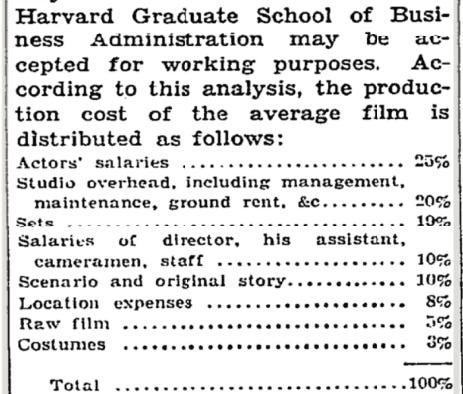
In the decade prior, top actors were paid about $100-$250 per week, or about $5,000-$13,000 a year—a hefty salary at the time. But once stars became big draws for their films and the modern celebrity was born from this star system, pay exploded. In 1914 Charlie Chaplin, one of the most well-known silent film stars, was bringing in about $150 a week. In 1916 he signed a deal that paid him an annual salary of $670,000. Another one of the most famous stars of the day was Mary Pickford. Her pay went from about $500 a week in 1912 to $10,000 a week in 1916. These stars were pulling in $1,000 a day or more at a time when $1,000 a year was a middle-class income. One of the highest-paid actors in the 20s, Harold Lloyd, was making about $1.5M a year.
To put this in another perspective, Paramount, the largest studio, made only $8M in profits in 1927. Other top studios were also profiting only $1M-$2M per quarter. So the amount that their top stars were making was a truly incredible amount. The ever-rising salaries and the increasing costs of production, especially during the transition to talkies in 1928, was a massive liability for the industry, which at the time was America’s fourth-largest, worth about $1.5B-$2.5B.
By 1929, the movie industry had essentially fully committed to the transition to sound movies and was spending money faster than they could make it on equipping theaters with sound systems and producing talkies and musicals. RKO had joined the ranks of the other studios as a major force in the film industry. The industry was engaged in one of its most capital-intensive initiatives in its history. Actors who were A-list stars just a year or two before were now facing unemployment as many of them found their skillsets out-of-date or insufficient for what audiences and the studios were demanding. The big five that would come to dominate the industry for years to come had been solidified in Paramount, Fox Film, MGM, Warner Brothers, and RKO.
With the transition to sound in full effect in 1929 and new stocks sprouting up in the exchanges every day, there were also a number of smaller companies that benefitted from this growth more than even some of the studios themselves. There were projector companies that saw a tenfold increase in demand in 1929. There were companies that provided movie and theater equipment that soared. Even small sound equipment companies and theater chains that jumped in price.
With the industry’s transformation from silent films to talkies now complete, the question for investors was which studios had positioned themselves to capitalize on it, and which hadn’t. The stocks told a complicated story
The Stocks
Founded in 1912, Famous Players Film Corporation, would list on the NYSE in 1919 as Famous Players-Lasky Corp. Eventually, in 1927 they would adopt the name of their film distribution subsidiary to become Paramount Famous-Lasky. To avoid confusion, I’ll be referring to this company simply as Paramount across the timeline. Paramount was the first of the movie companies to list shares on the NYSE although, also in 1919 Loews Inc. was traded in Philadelphia.
At this time, Paramount was the dominant force in the movie business. They were the largest film producer with a fully vertically integrated model. They made the movies on sets they owned, did all the editing in-house, distributed the films through their distribution subsidiaries, and owned theater chains where their movies were played. In the late 1910s, Paramount created the practice of block booking—forcing theaters to buy blocks of movies rather than individuals. Essentially, if a theater wanted to show a particular Paramount movie, Paramount refused to sell individual movies to them. If they wanted that movie they would have to purchase a block of Paramount films, guaranteeing many of their films would be shown in theaters, not just the hits.
Paramount’s stock remained decently liquid through the bull market. For its first few years on the exchange it mostly traded between a split-adjusted $15-30, rising a little over $40 in 1926. Between 1927-1929 it rose from a low of $31 to a high of $75 less than a month before the crash.
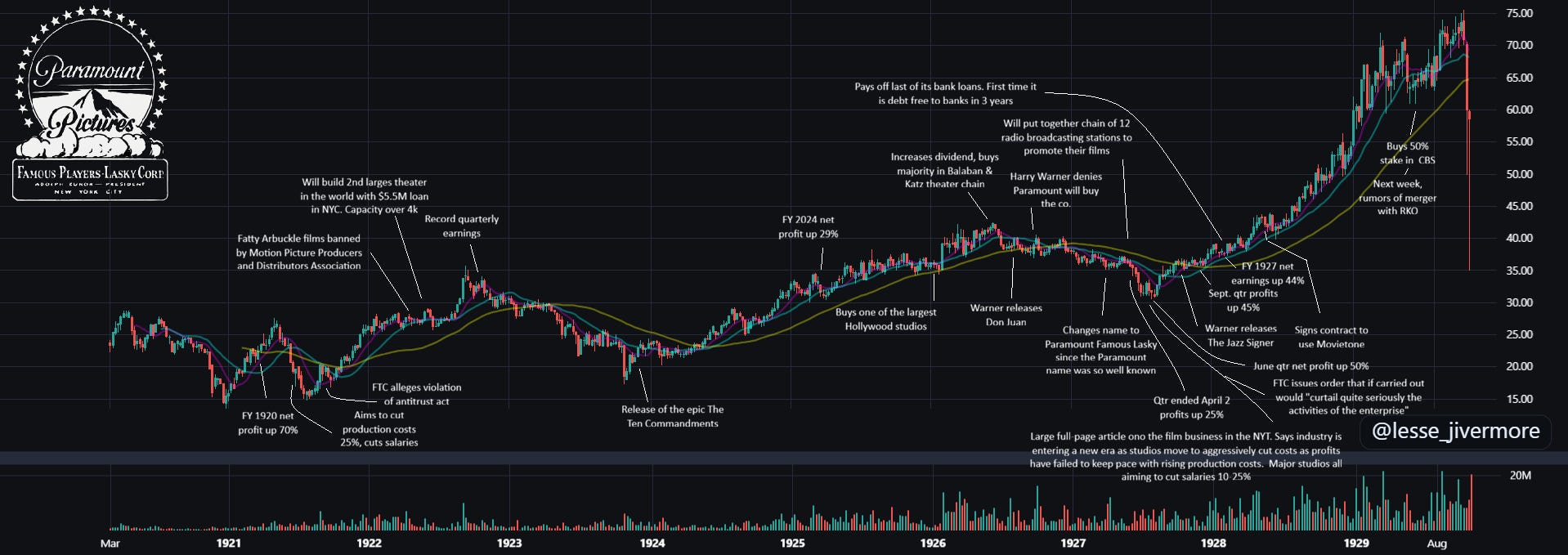
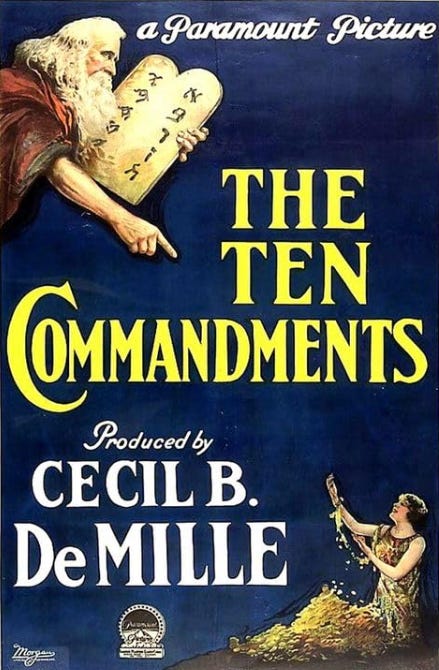
Although Paramount was the industry leader it really didn’t see a big increase in sales in the decade and profits mostly stayed relatively flat with a few exceptions. Although the stock more than doubled after the release of “The Ten Commandments” in late 1923, and again from 1927 as the industry began to move towards talkies, the rise in the stock was relatively mild in comparison with some of the others in the group.
Since 1921 Paramount had been dealing with antitrust investigations centered around its practice of block booking. The FTC claimed it was a violation of the Sherman Antitrust Act and inquiries into Paramount lasted throughout the decade. But it wouldn’t be until the 1940s that the studios would be forced to separate their theater and filming businesses.
1919 was a short-term peak for many industries, the film business included. Paramount was listed on the NYSE, Loews Inc. in Philadelphia, and Goldwyn Pictures traded on the Curb Exchange. They were quickly taken lower with the bear market that arrived in early 1920. Loew’s Theatres traded down to an adjusted $8 in 1921 from $30 in 1919. Goldwyn sank from $35 to $3 after hitting major financial difficulties. Rising production costs, competition from other studios, and poor box office sales sent the company into a downward tailspin.
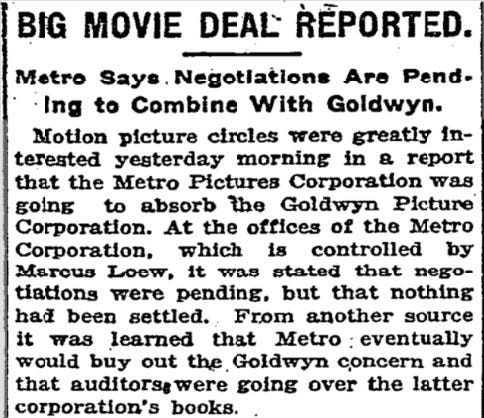
With the rise of the vertically-integrated studios like Fox and Paramount, Loew’s Inc., the nation’s largest theater chain, faced a big problem: the major film studios owned the production, distribution, and theaters. In order to compete they decided to purchase a film studio of their own. In 1919 they acquired Metro Pictures. Metro was a midsize studio with not much notable about them, although they did own a distribution company. Then, in 1924 Loew’s organized a merger between Metro pictures, the struggling Goldwyn Pictures, and Louis B. Mayer Productions to create Metro-Goldwyn-Mayer Pictures. The new studio wasn’t an immediate top-tier studio, but they had a large amount of high-quality assets and emerging talent.
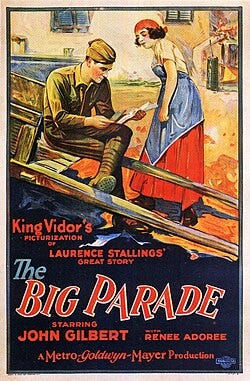
The company was turning out a film every week, similarly to Fox and Paramount. Their first breakout hit was “The Big Parade” in 1925. It became the biggest hit of the decade and the highest-grossing silent movie since the release of “The Birth of A Nation” was released in 1915. Just a few weeks later they released “Ben Hur,” one of the most successful films of the decade, lauded for its technical achievements and its extravagant sets. It was also one of the most expensive movies ever filmed to date. These two films, along with others to follow, cemented MGM as a top-tier prestige film studio. Having access to Loew’s massive chain of theaters also meant they had a steady supply of demand to show their films.
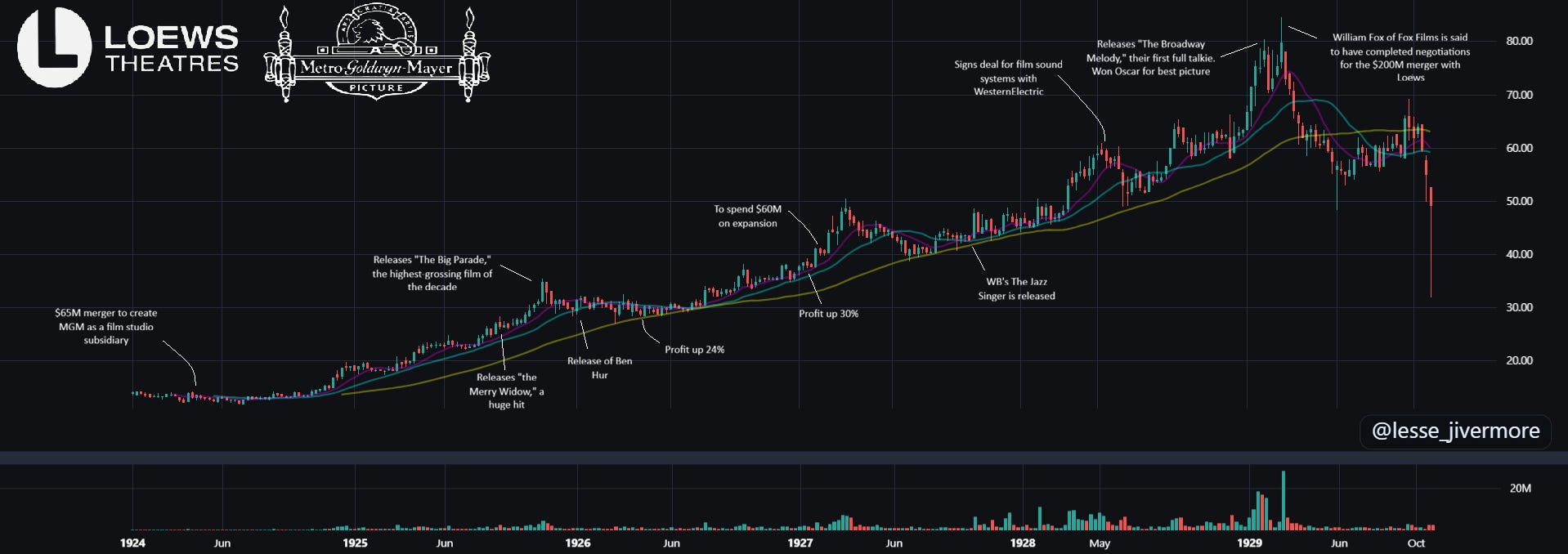
Loew’s performed much better than Paramount, rising from just under $12 in 1924 to $85 in 1929. But it should be noted that none of the weekly charts in this post have been adjusted for dividends, so their real returns were higher than what is shown on the charts. Even though MGM was the last of the major studios to convert to sound, they still made the move in 1928-1929. It’s very likely that the addition of MGM in 1924 helped Loew’s grow more than Paramount.
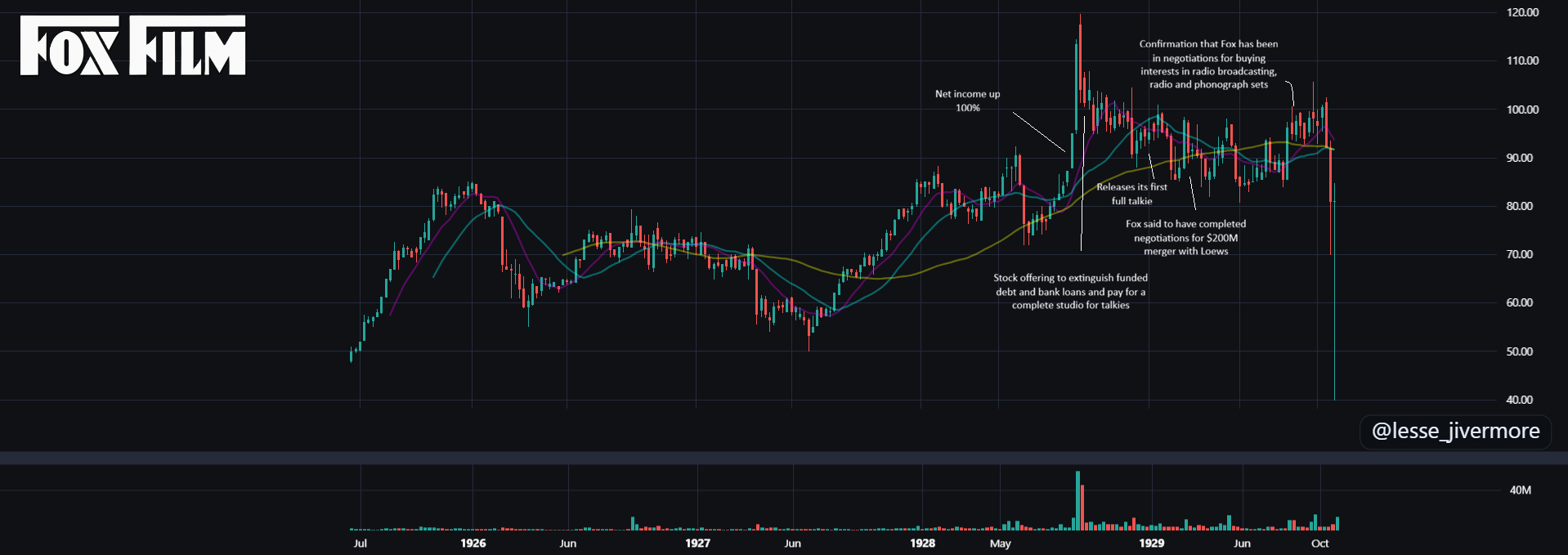
Another one of the major studios of the era was Fox films. Fox was often the secondary leader in the industry behind Paramount and was rivaled only by MGM after its rise in the mid 20s. The founder and president of the company, William Fox, was one of the most aggressive of the Hollywood moguls. He pushed theater expansion hard to solidify his position in the industry. Although not as well-known today, Fox’s films weren’t the biblical epic blockbusters that Paramount and MGM produced. They popularized the western movie and leaned hard into the development of sound films.
Fox was an early adopter of sound, acquiring the Movietone sound system in 1926. One of Fox’s strengths was creating news reels. Oftentimes before the main film to be played in a theater, they would play news reels as a show before the main event of the night. One of the biggest reels Fox made was in May 1927 on the transatlantic flight of Charles Lindbergh, complete with sound. The Movietone recordings of Lindbergh taking off from New York and speeches he made just afterwards were widely popular with audiences. Theaters across the country paid Fox for these news reels, which were often more profitable per minute than feature movies.
Fox, although one of the preeminent film studios of the decade, had a stock chart that didn’t quite show it. It did have a 140% move from its 1927 low to the high in the summer of 1928 amid rumors of a large consolidation of movie stocks. Even when it was reported that Fox had reached a deal to buy Loew’s in 1929, a deal that would have given them control of MGM and made them instantly the top studio in Hollywood, the stock hardly budged. Then, just weeks before the crash in the market, William Fox was in a different kind of crash. He suffered life-threatening injuries in an automobile accident that put him in the hospital for several days. That, plus the violent crash in stocks spelled doom for his deal to take over MGM.
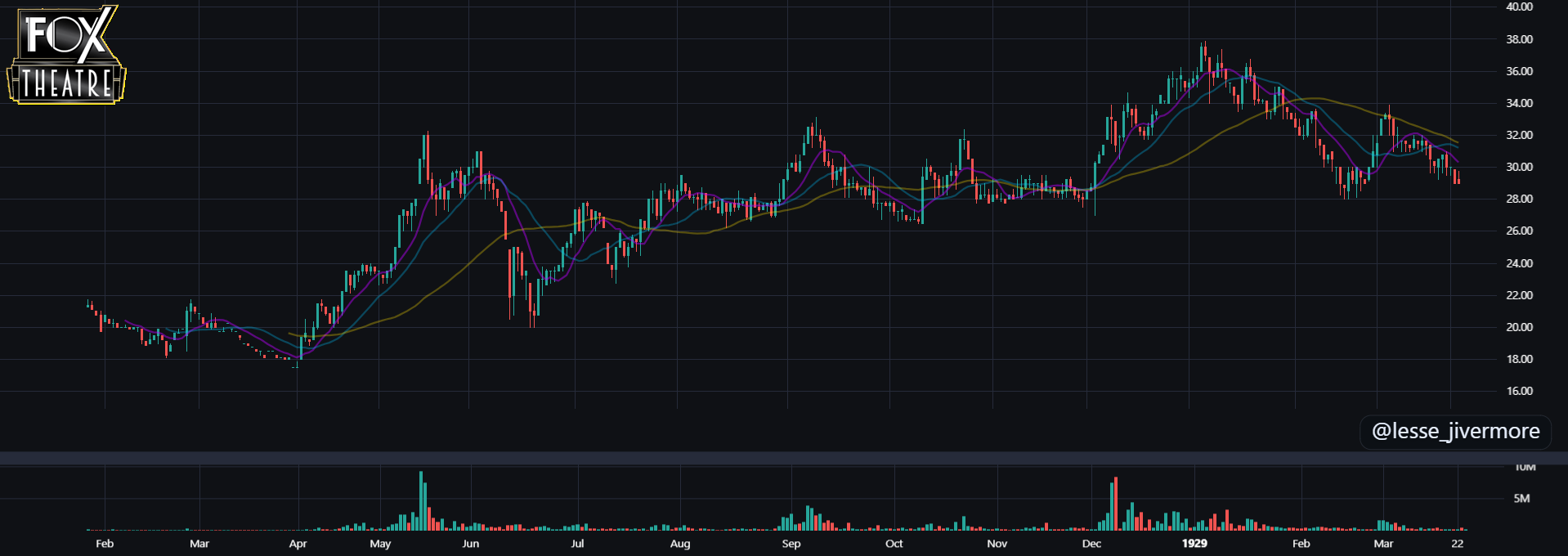
In late 1928, Fox Theatres was spun-off into a separate company that traded on the Curb Exchange. Although it got quite liquid in spots, it was not a major factor in the group in 1929.
Rising Stars & Small Caps
Among the industry’s leaders like Loew’s and Paramount, there were smaller entertainment stocks that also had a notable presence in the market if even only for a single day.
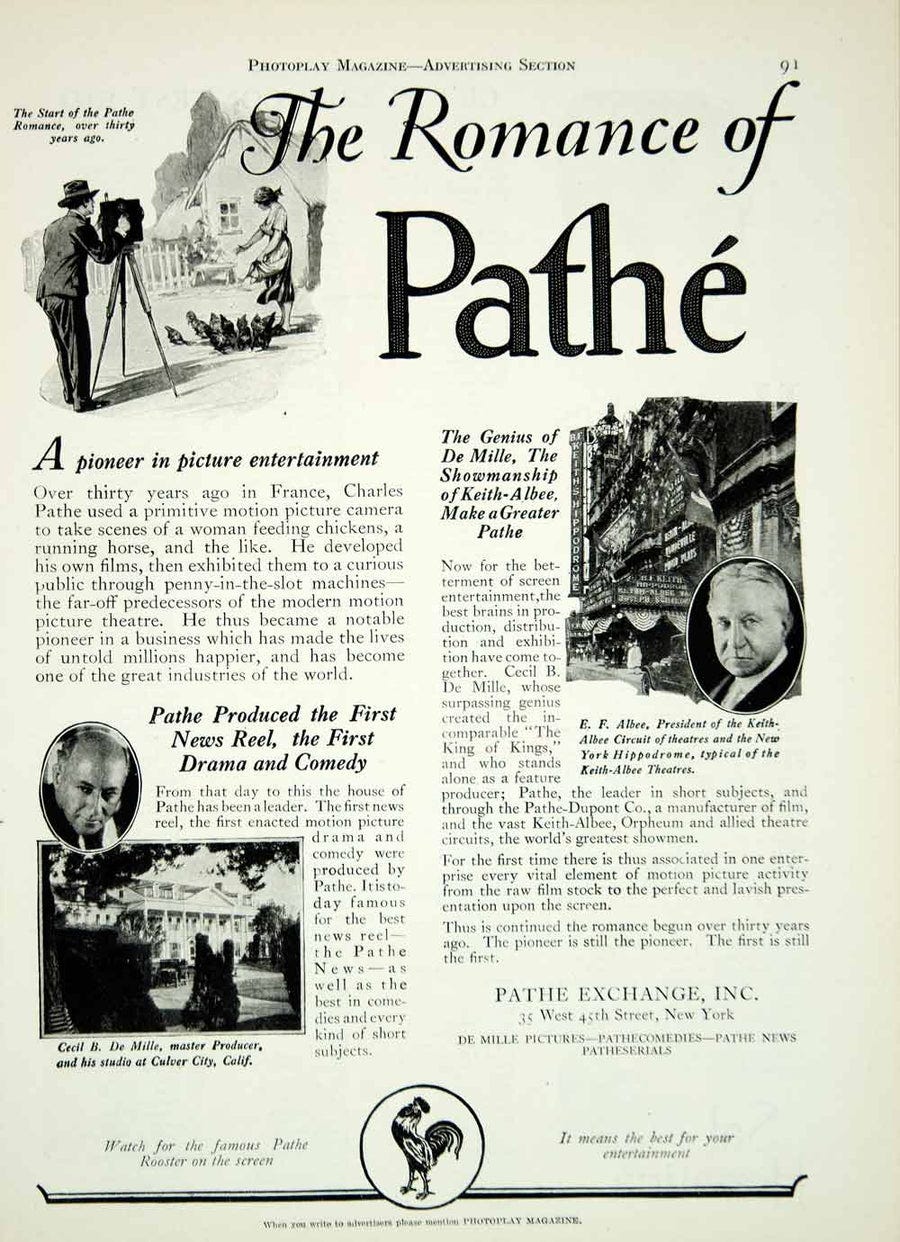
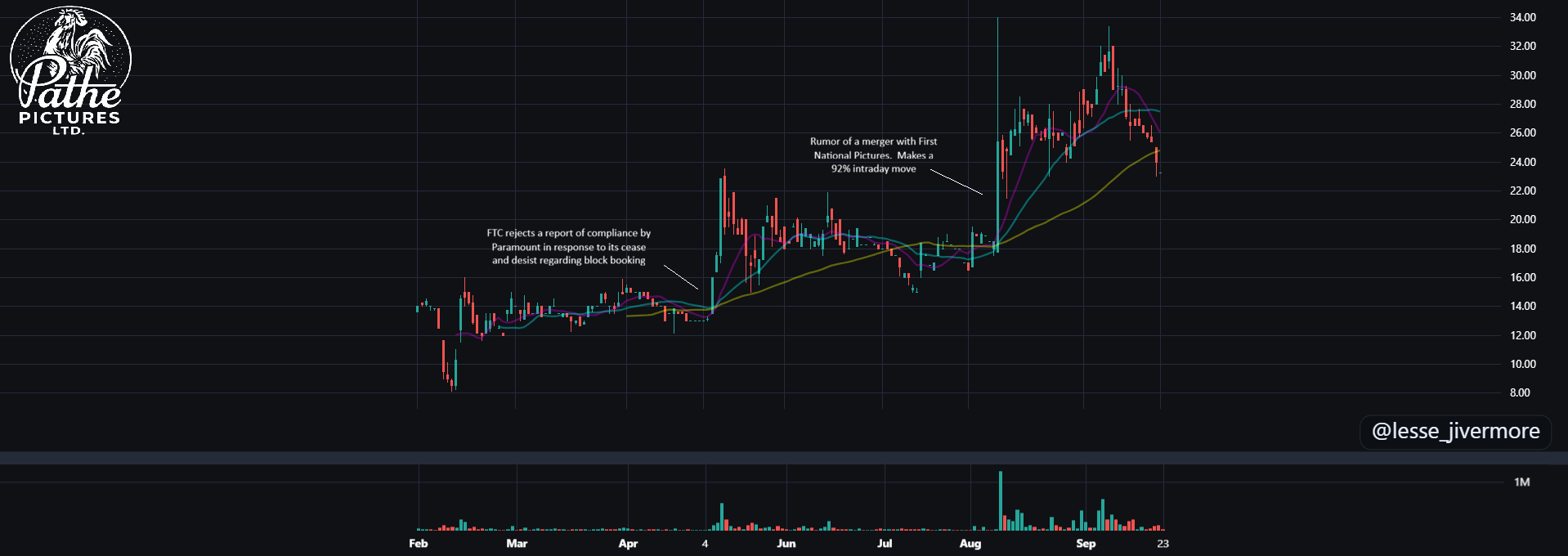
Pathé Exchange was the American branch of the French Pathé Frères. Pathé dominated short serial films and news reels in the silent film era. Pathé Exchange was a major film distributor in the 1910s and 1920s. For most of its life on the Curb and later on the NYSE, Pathé was a thinly-traded, unremarkable stock. It doubled in 1925, but then continued to sell off from its high of $84 to a low of $8 by early 1928 when the bull market was entering its best year.
After quickly recovering from this low point, it gained on news of the FTC rejecting a report of compliance made by Paramount in response to their cease and desist on block booking. Several weeks later in early August rumors of a large rollup being planned in the industry sent shares of several movie and entertainment stock soaring. Pathé was the standout performer on this day rising just shy of 100% intraday—an intraday gain that was nearly unheard of at the time. And when you realize the average person was likely using 5-10x leverage to buy their shares, it must have been an incredible sight to behold for traders of that era. But like any thin pump stock of today, Pathé continued its decline through to the crash.


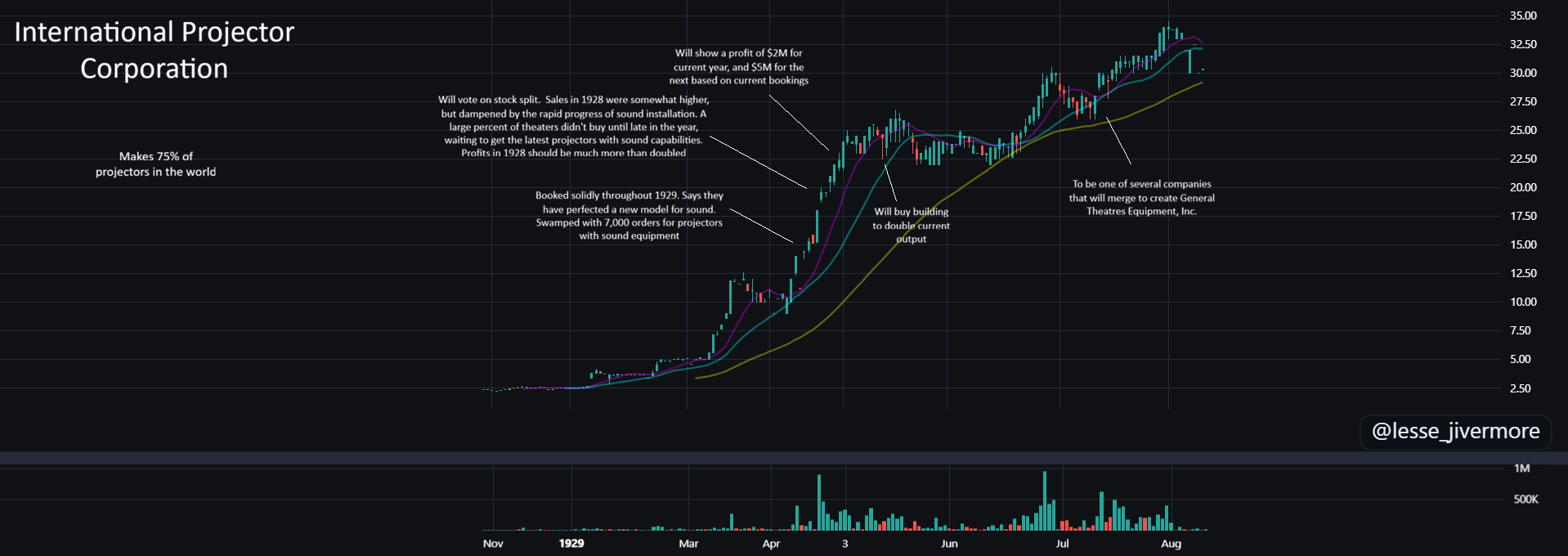
Another thin penny stock in the group was the International Projector Corporation (IPC). Traded on the Curb Exchange. IPC made 75% of all movie projectors in the world. The industry’s pivot to fully embrace sound movies was a major boon for the company. In 1929 they reported profits in 1928 were more than doubled from the prior year even though sales were only somewhat higher as many film companies waited until late in the year to purchase the latest models with sound capabilities. It showed profitability of about $2M with projections for $5M (Paramount was making about $8M per year, the premiere movie studio in 1929). They were booked out for the remainder of the year by the end of April with 7,000 orders for projectors with sound equipment.
The incredible business they were receiving resulted in the stock soaring from under $2.50 to nearly $35 in just a few months before they were merged with other companies into a new entity called General Theatres Equipment (GTE). GTE was exactly what you think—they made and sold various movie and theater equipment. One of the notable products they sold was a widescreen projector that was said to give the images it projected the appearance of having three dimensions.
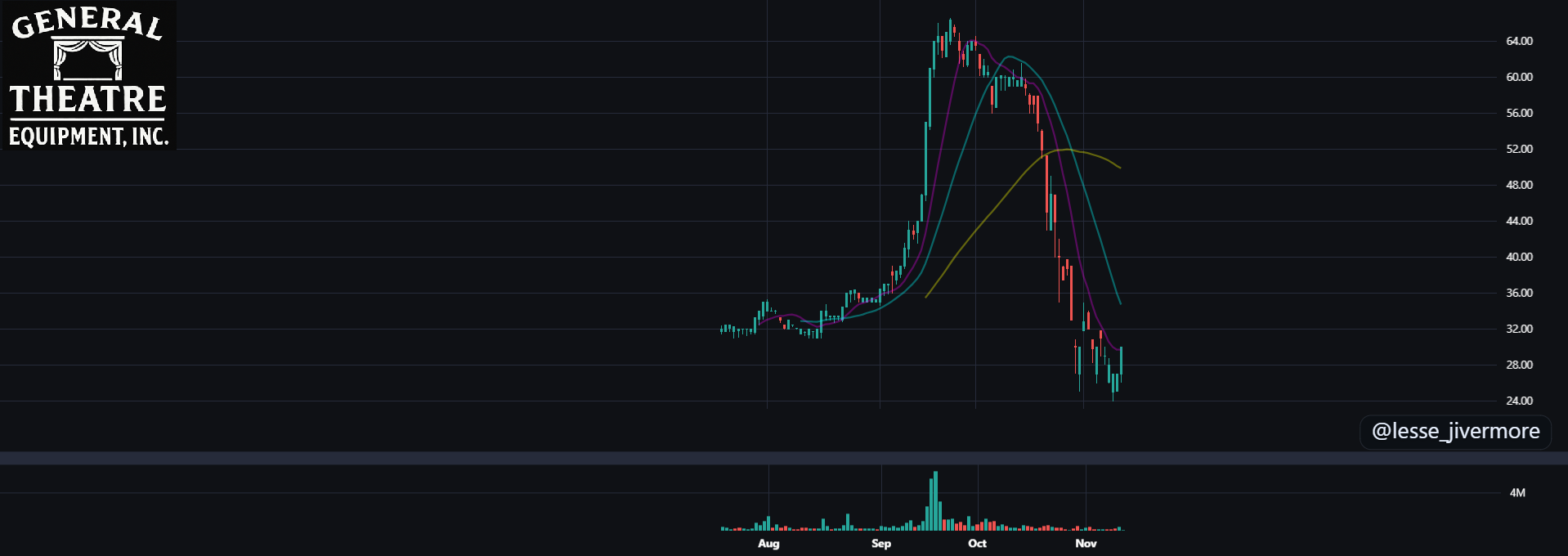
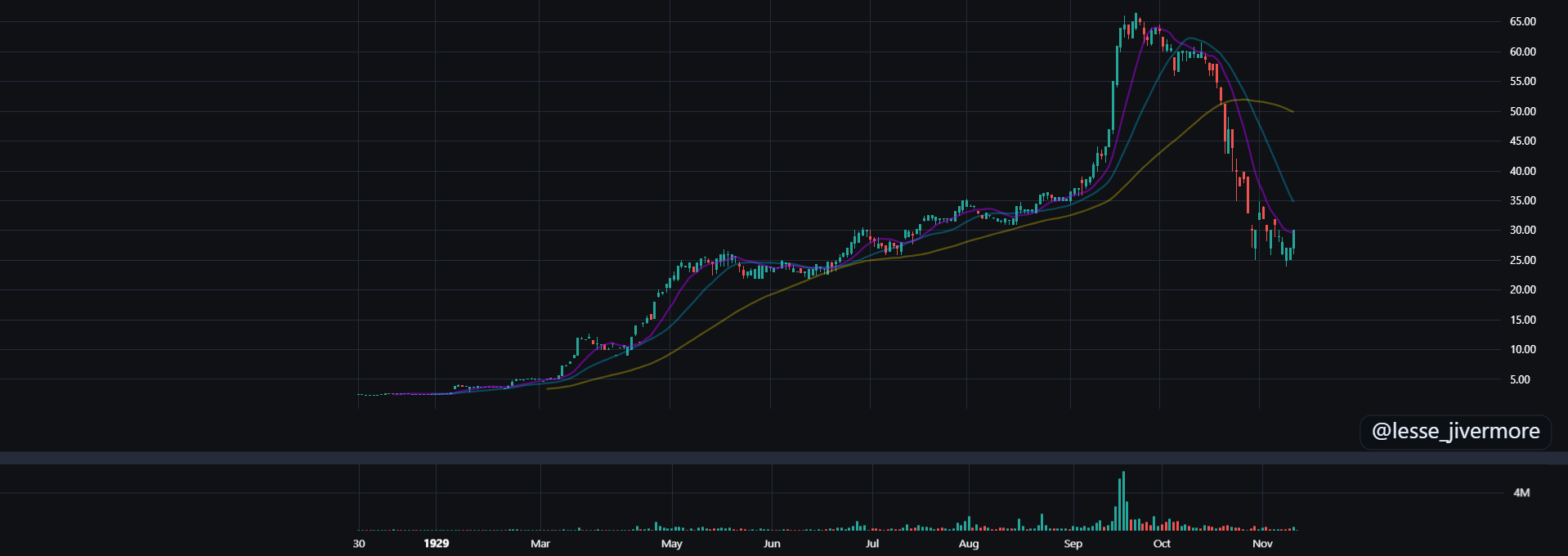
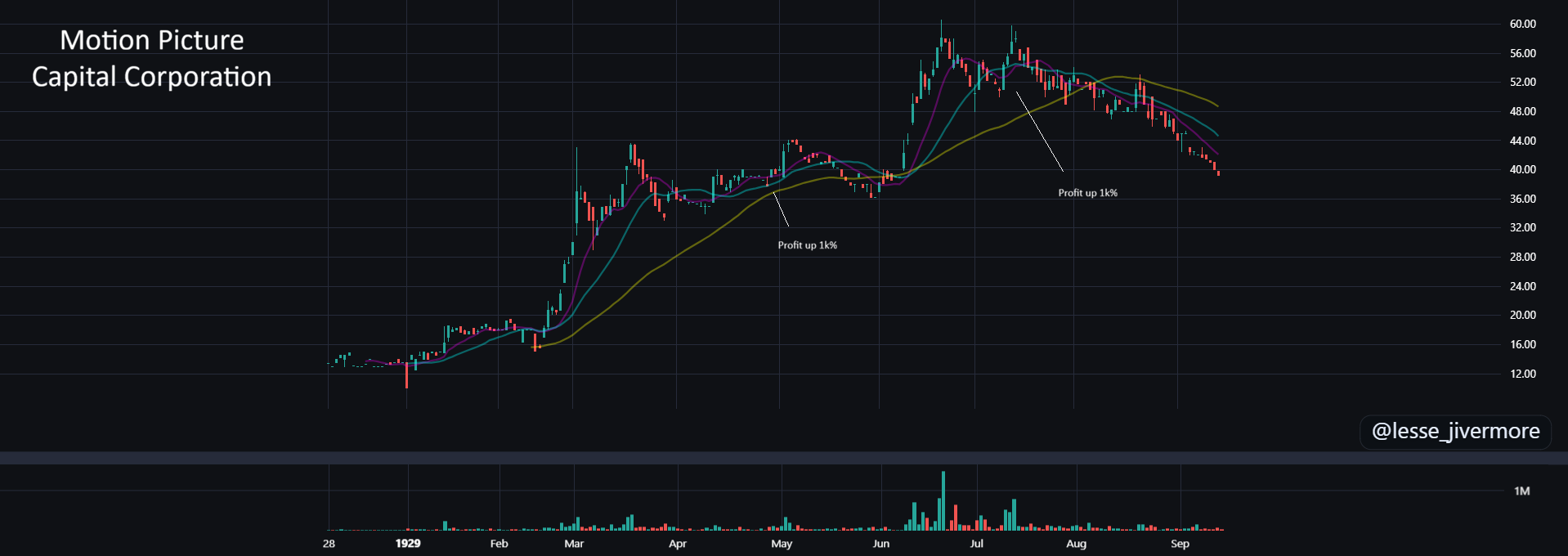
Before getting into some of the other stocks in the film industry, here is the Motion Picture Capital Corporation. There was virtually no significant news I could find on them, but it deserves to be included in this post.
The general manager of Fox Films said in July of 1929 that the industry had already spent $50M on converting to sound—an incredible sum for that time when the larger studios were only bringing in a million or two in annual profits. He went on to say that although since the talkie came about they had been doing about 30% more business in their theaters, the costs to produce a talkie were 25-35% greater than to produce a silent film. All of this money was great news for the suppliers of the movie business, but was another source of uncertainty for the studios themselves as greater input costs would mean greater potential losses on films that flopped.
Another related stock, that remarkably still trades OTC today, is the Trans-Lux Corporation (TNLX). In the 1920s TNLX wasn’t a movie company. In 1923 they created the first electronic ticker board. It was essentially a large electronic screen that displayed the results printed by the stock ticker. It revolutionized the way traders kept tabs on the market. Before this invention, traders elbowed each other for position over the ticker machine to get the best view of the freshly-printed quotes. But with the TNLX quote screen anyone in the room could clearly see the tape in real time.

TNLX leased their screens to major exchanges and loads of brokerage houses across the country. They also made a large movie screen, a rear projector, and a wide-angle lens for the film industry. People would gather in hotel lobbies and brokerage houses just to sit and watch the screens show the day’s market activity scrolling by on the TNLX ticker board. The Associated Press, in an article from 1928, mentions:
“This has whetted the speculative appetite of thousands and created many new ones, the thrill of seeing one’s stock quoted at advancing prices on a heavy turn-over being akin to that of the race track devotee who sees the horse on which he has placed his bet come thundering down the home stretch in advance of the field.”
TNLX, soon after the crash, partnered with this next stock to open a chain of theaters and get more involved in the movie business.

In the time of silent films, vaudeville still played a big role in live entertainment. Keith-Albee-Orpheum (KAO) was a large chain of vaudeville theaters that specialized in showcasing live shows. They were the largest live entertainment chain in the country with over 1,000 theaters. As the film industry expanded, especially after the talkie was introduced, vaudeville was facing an existential threat. They began to incorporate short films and news reels before the main act in an effort to compete. Many in the movie industry were predicting the talkie would devastate vaudeville. And they were right.
In late 1928, the Radio Corporation of America (RCA) merged its interest in the Film Booking Office of America, a small Hollywood studio, with KAO to form Radio-Keith-Orpheum, or RKO. FBO was their film studio, KAO had a massive theater chain, and RCA had bottomless pockets and one of the best synchronized film-sound systems in the world.
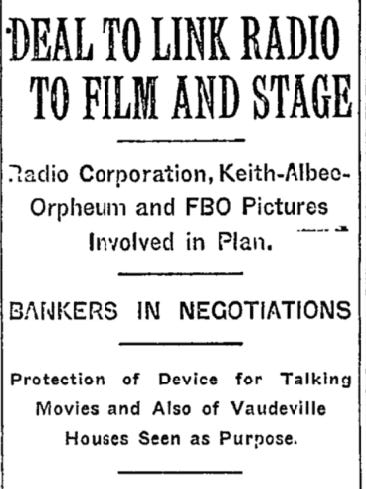
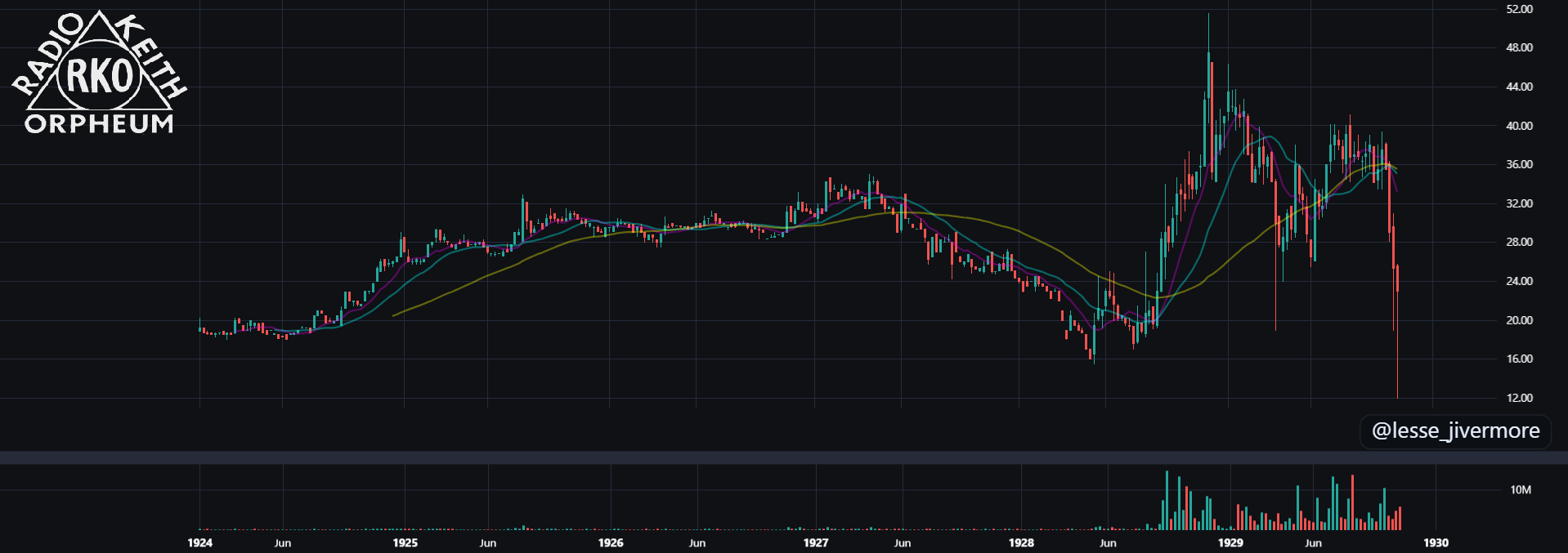
This merger sparked a massive increase in the interest of the stock of KAO, and the later RKO. Again, for whatever reason, even though RKO had the direct backing of the hottest stock and most powerful technological leader in the world in RCA, the stock appears to have defied expectations. Volume jumped 20-50x but the price only rose from just under $20 to just under $52 before turning over and struggling throughout 1929 into the crash.
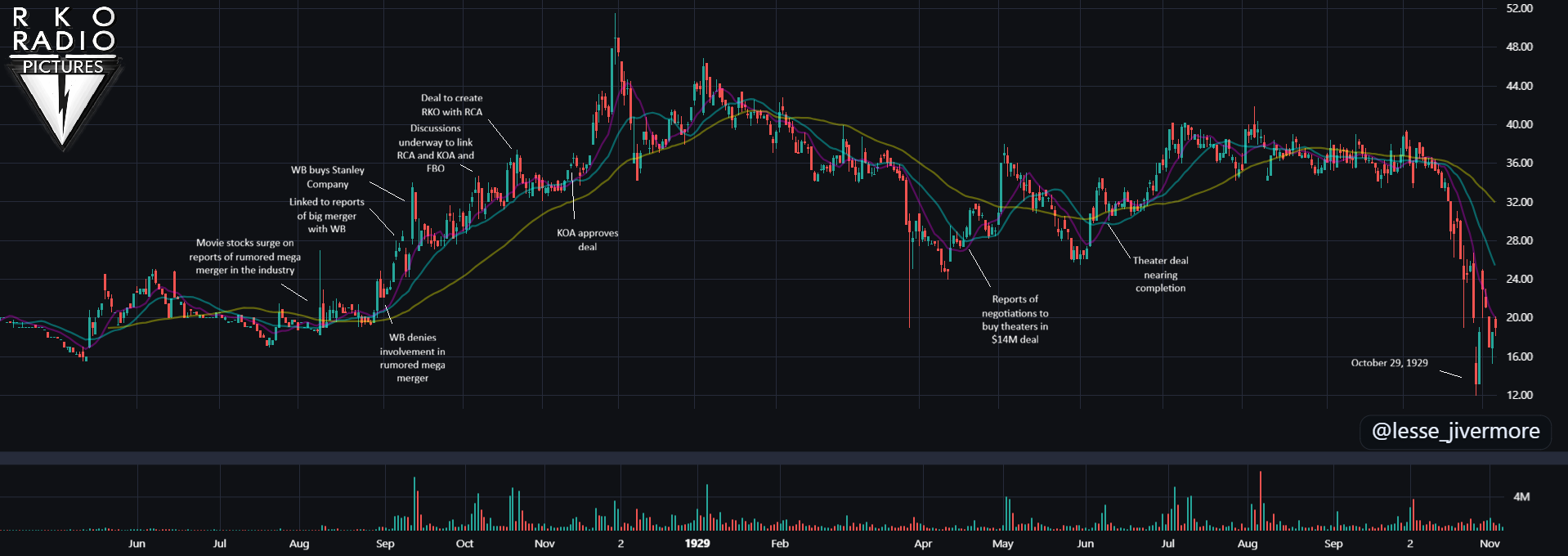
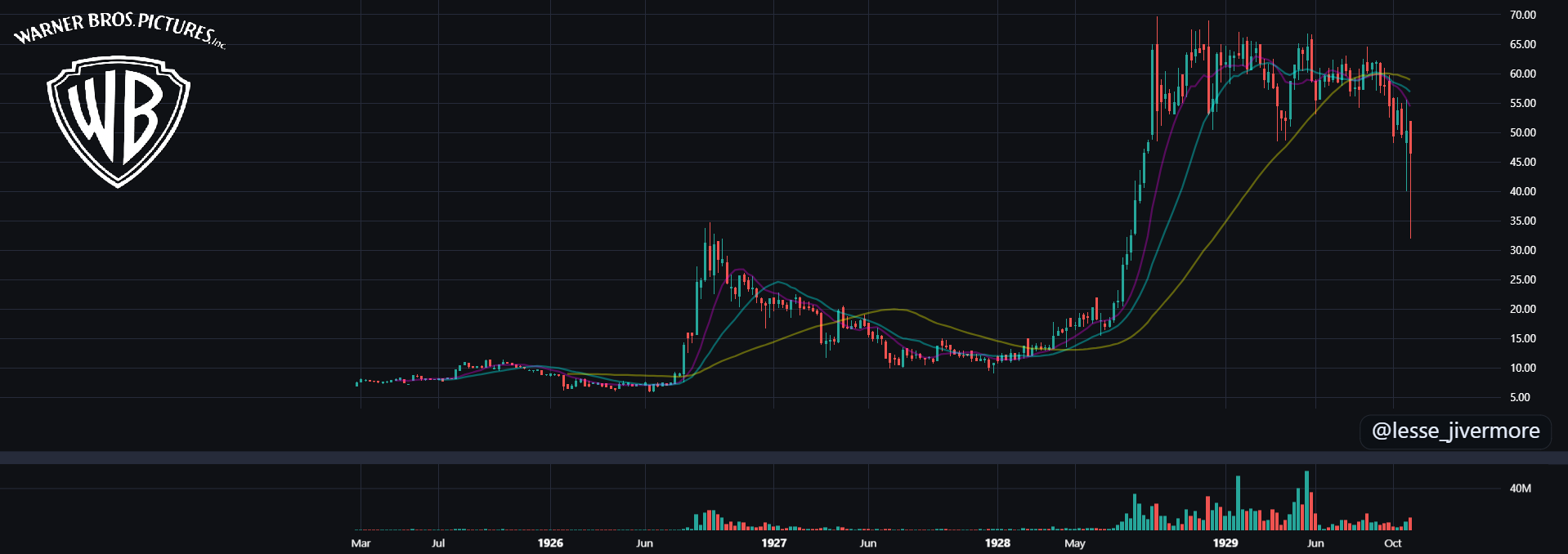
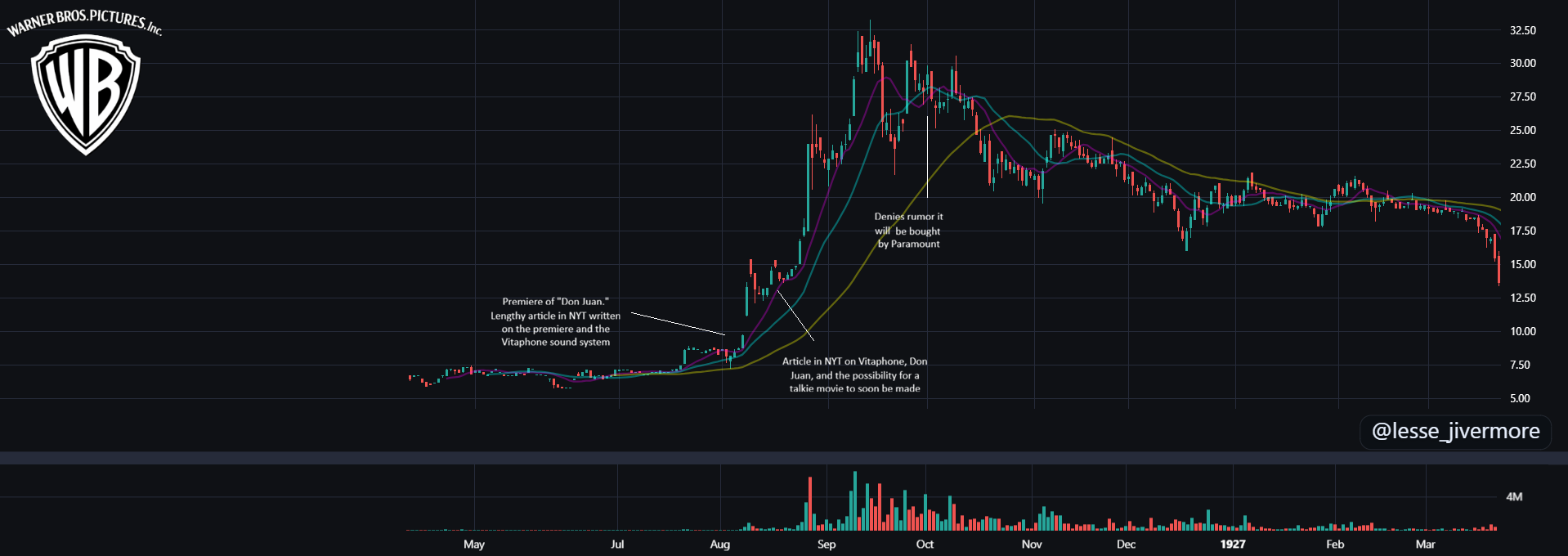
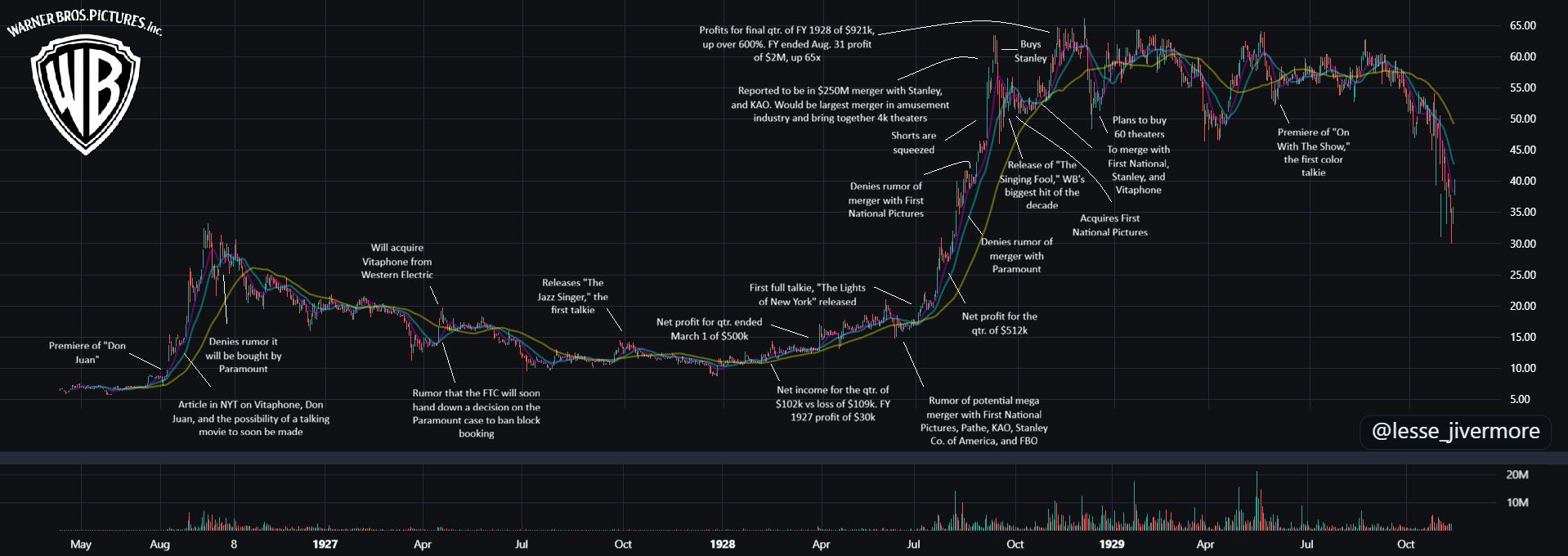
The last of the major players in the movie group of the Roaring Twenties was, of course, Warner Brothers Pictures (WB). WB was a relatively small, mid tier studio in 1925 when they listed their shares on the New York Curb Exchange. The stock was a non factor in the market for well over its first year. Then, as mentioned earlier, with the release of “Don Juan” in the summer of 1926, their stock shot up.
Their gamble on sound films paid off as “Don Juan” was an instant hit for the novelty of hearing not only a synchronized soundtrack to the film, but also the sound effects such as clanking swords that could be heard during sword-fighting scenes. The stock rose from $6 to $34 in a few months on heavy volume.
After this successful release, WB immediately began working on their first film with talking actors, “The Jazz Singer.” The stock continued to decline after its 1926 peak and traded down to $10 just before they released “The Jazz Singer” in late 1927. The day before the film premiered, Sam Warner, who had played the central role in getting WB to embrace sound in their movies, died at the age of 40.
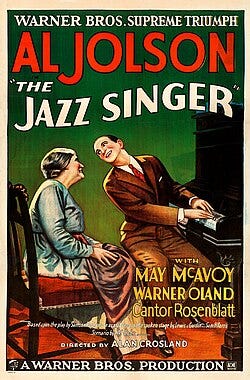
Even though “The Jazz Singer” was an even bigger hit than “Don Juan” the stock barely reacted, moving up to a little under $15 ahead of its release on light volume. As soon as the movie was released the stock went back to its seemingly endless decline until it bottomed out around $9. Then something truly remarkable happened.
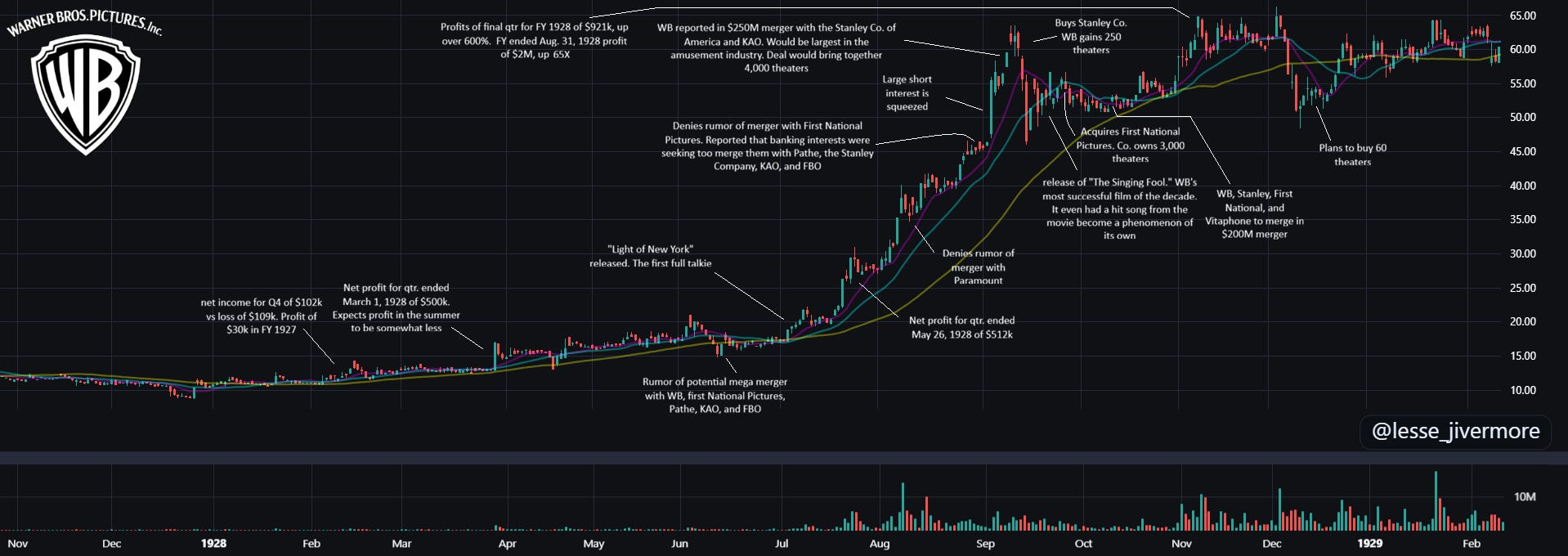
Warner was in a precarious financial position prior to “Don Juan” and “The Jazz Singer.” They didn’t have much box office success with their films and borrowed heavily to bet the company on sound. But 1928 would be the year that they finally found lasting success and broke into the ranks of the top studios in the industry.
Profits in 1927 were only $30,000. In several of their 1927 earnings statements they were losing $100,000 and only occasionally making money. Then for the quarter that ended March 1, 1928 they made a profit of $500,000 alone—that’s well over 10 times their profit for all of 1927. The stock slowly became more active and kept grinding higher until they released the very first full feature-length talkie, “The Lights of New York.” While “The Jazz Singer” is considered the first talkie, it only contained a few minutes of dialogue and some singing while the majority of the film was silent. The movie was another big hit and notably cost only $23,000 to produce and made WB $1M. The stock once again became liquid and shot up from under $20 to $66 in early 1929.
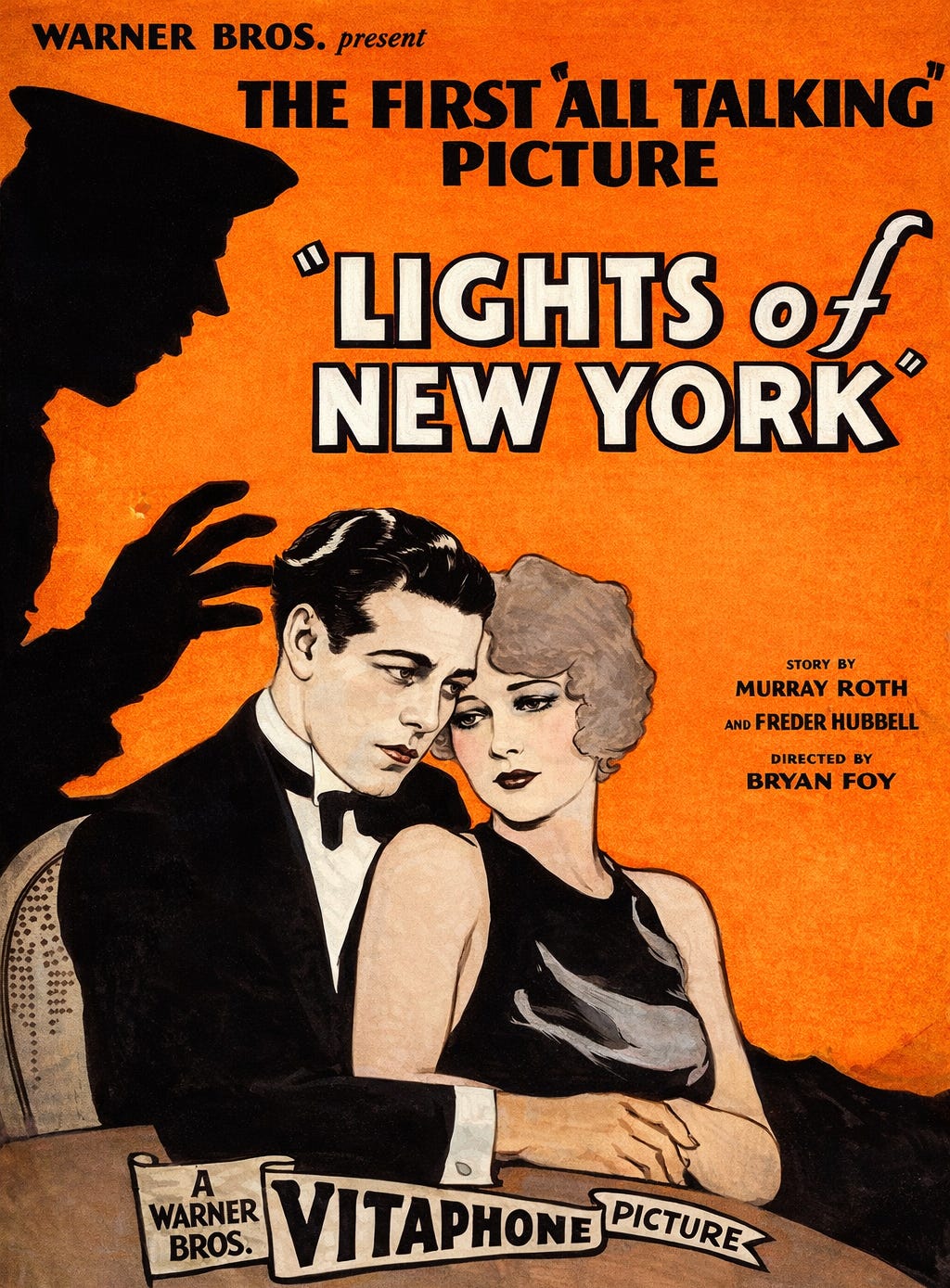
Shortly after the film’s release, WB released another earnings statement showing a profit of over $500,000. As Warner became the undisputed leader in the talkie revolution and was named in some rumored blockbuster mergers, the profits kept piling up. The profits recorded for the last quarter of FY 1928 alone showed a profit of $921,000 and a FY 1928 profit of $2,000,000.
With their newfound success, they began to acquire other companies including First National Pictures, one of the nation’s oldest and previously one of the most prestigious studios in Hollywood. They had faced a decline in the 1920s from competition from Paramount and MGM, but they were still larger than WB when they were acquired. WB went from being a mid tier film studio to a competitor with the industry’s elite essentially overnight as they gained First National’s film library, a chain of theaters, and a distribution company. WB bought more theaters and was the true growth stock in the movie business in the decade.
Their innovation and firsts didn’t stop at sound as later in 1929 they released the first fully color talkie, “On With The Show.” But not even that novelty would be enough to save them from the crash a few months later. As you can see from the chart, WB’s stock was actually one the stocks that held up best during the initial crash. Although, it, too, would ultimately be devastated in the next few years, it didn’t fall as violently as some of the other growth stocks of the time.
Although the stocks of many of the leaders of the film industry may not have lived up to expectations in their first bull market in the 1920s, surprisingly, they would come to make some of the best moves of the following decade. The leaders of the industry in the 20s would, in the 1930s, be joined by Universal Pictures and Columbia Pictures. Nearly all of these film studios would make five-figure percent moves from their devastatingly sharp declines off the 1929 peak.
Sam Warner never got to see how the story ended. He died just one day before the premiere of “The Jazz Singer,” the film that would vindicate everything he had bet the company on. By 1929 Warner Brothers had gone from a cash-strapped mid-tier studio to one of the five companies that would dominate Hollywood for decades.
The lesson the movie group of the 1920s offers is that even a sector undergoing rapid technological transformation, dominating headlines, and minting new millionaires can still produce stocks that disappoint. The biggest winner wasn’t the industry’s established giants. It was the desperate smaller company willing to bet everything on a technology nobody else believed in.
Notes
-Most charts are weekly unless otherwise stated
-Moving averages are 10, 20, 50 period
-All daily charts have been adjusted for any ex dividends and ex rights. Weekly charts have not been adjusted
Thank you so much this was a great read. I love the charts added on to this, I was wondering if it’s possible to share some log charts as well, they are much easier to read. Amazing work either way this deserves much more credit.